
How Lee’s Library Is Leading with Solar and Storage

You may not have realised it, but the Lee Public Library has quietly become one of the most forward-thinking buildings in town.
For years, Library Director Hayley Van-Gils has been used to juggling big dreams with small-town realities. The process of renovating has spanned decades, and has ranged from considering entirely new buildings and capitol campaigns to remodelling attempts, with significant efforts from library staff and trustees to complete the additions and basement remodelling Every improvement required back-and-forth meetings with the Select Board, tight budgets, and patient explanations about what a modern library actually is.
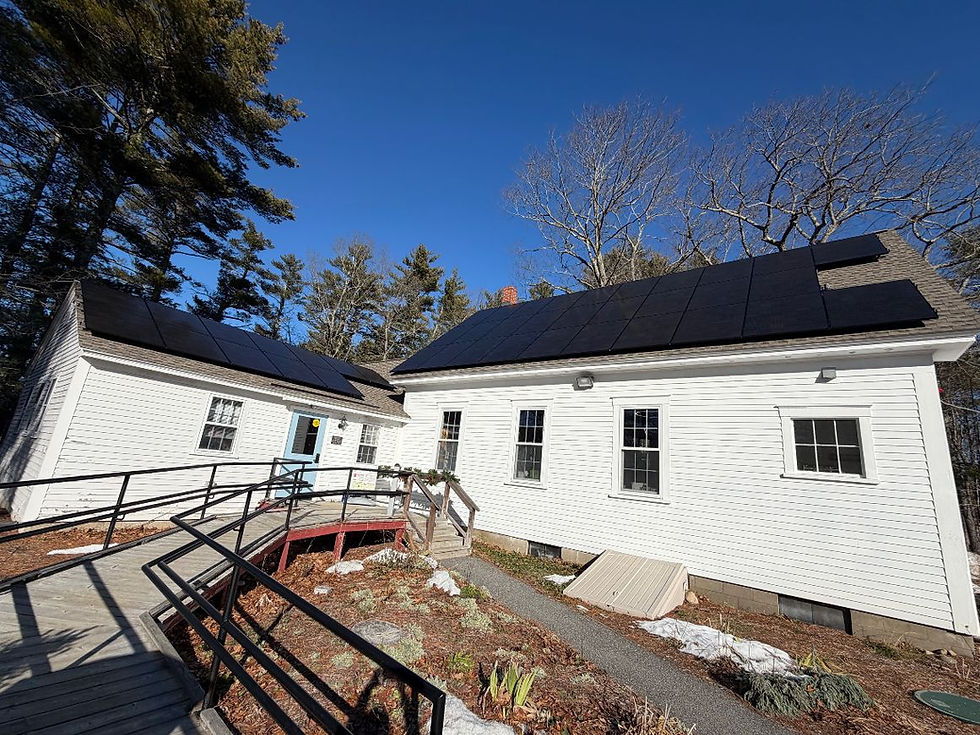
As Hayley and library patrons can tell you, it’s not just a place for books. It’s a community living room. A safe after-school hangout. A warm place during winter storms. A space where someone new to the area can spend long days with young children and feel less alone. “If we had no books in the building,” Hayley says, “we would still be a community space.” Now, the library has taken on its most ambitious project yet: a municipal solar and battery storage system that will transform it into a true resilience hub for Lee.
From Complicated Process to Community Model
For towns like Lee, energy projects can feel daunting. Katrin Kasper, Clean Energy NH’s Seacoast Energy Circuit Rider, who lives in Lee, first connected with the library years ago. Through that early involvement, she saw firsthand how complicated it can be to move energy projects forward in small towns.
“There really wasn’t anyone who knew what we needed to do to make sure projects got done,” she explains. When she joined Clean Energy NH, she was excited to become that person: someone towns could call to understand funding opportunities, navigate paperwork, and learn what had worked elsewhere. Working with the Lee Library became a proving ground. Together, they explored what once felt out of reach—solar panels, battery backup, long-term savings—and turned possibility into a plan.
Why Solar and Batteries?
Lee experiences two to six power outages each year. Some last days. One cold February in 2023, a generator failure at the public safety complex. Another day, the old town hall, which resides next to the library, lost power and battled bursting pipes. The library, notably, has never had a generator. When the power went out, it simply closed, sometimes for up to a week.
And yet, when the lights go out, access to books, information, and community support is exactly what people need most.
As a parent who once brought her children to the town’s emergency warming center, which was warm but featured cold concrete floors, folding tables, plastic chairs, Katrin has seen firsthand the benefits of the library serving in this role instead. Renovated, welcoming, filled with light, it already felt like home. Why not make it resilient, too?

The answer became a 17.835 kW solar array (41 high-efficiency 435W panels paired with Enphase microinverters) and three Enphase 10C battery units. The system is designed to generate 110% of the library’s electricity load, with room for future upgrades like heat pumps. Battery storage will maintain critical systems for at least 48 hours during an outage, until the sun returns, and then the system can run indefinitely. That means heating controls, cooling, lights, water pump, refrigerator, microwave, and essential computers will continue running. In winter, it provides warmth. In summer, it cools the building down, perfect for community members to enjoy the space on a hot summer day.
The Budget Reality
For a small library running on a tight annual budget, electricity isn’t just a line item, it’s a stressor.
“Our most recent electric bill was astronomical,” Hayley explains. When utility costs spike, the money has to come from somewhere else. Programming. Books. Digital subscriptions. All of these things define the library’s daily impact for the surrounding community. The Friends of the Library often step in to fundraise and soften the blow, but the tradeoffs are becoming overwhelmingly real. When electricity costs more, something else gets less.
Solar changes that equation. It stabilises operating costs and frees up dollars for what matters most: community services. The library will even install a public display so visitors can watch energy production in real time. In a building devoted to learning, the solar array becomes a teaching tool. “I cannot wait until the minute we have some sun and I see those numbers rolling in,” Hayley says.
Building Access, Building Resilience
This project builds on a track record of thoughtful investment. In recent years, the library secured three American Library Association grants focused on accessibility, including funding dual-height sinks, automatic door openers, and improvements to the wheelchair ramp. Every change reinforced a simple principle: everyone belongs here. Solar and battery storage help make that happen.
When the next storm knocks out power in town, the Lee Public Library won’t go dark. It will glow. Lights on. Heat running. Doors open for the community. And that feels perfectly aligned with what Hayley has said all along: a library isn’t just a place to borrow books. It’s where a community gathers, learns, and takes care of one another, even when the grid goes down.


Comments