
Find the Magic in Energy Education with NHEEP

“I’m going to do a magic trick. Are you ready?” NHEEP educator Angie Krysiak flipped the
classroom light switch, and the lights came on. Some kids snickered, others rolled their
eyes. “Okay, so it’s just the lights coming on. But who can explain to me what happens
when I flip the switch?”
The kids looked at each other, unsure. Finally someone raised a hand and suggested “the electricity goes through the wires?” “Yes! And can anyone tell me how the electricity got into the wires in the first place?” Silence.
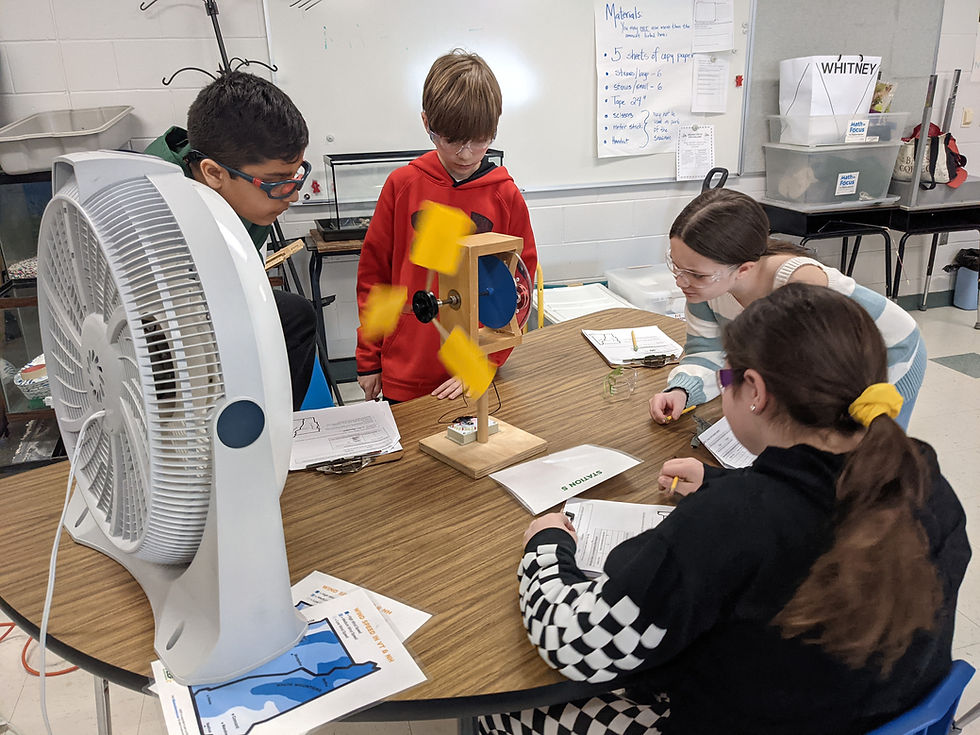
Over the next hour, students explored a series of hands-on stations where they learned
how to complete an electrical circuit, power up a series of devices, and figured out the
“three ingredients” of electricity. Once they had a basic understanding of how it worked,
they explored the different ways we generate electricity, and the pros and cons of each
generation method.
Programs like this one, “Electricity and the Environment”, designed
and delivered by educators at the Vermont and New Hampshire Energy Education
Program (VEEP and NHEEP), help students understand where our energy comes from,
and the impact that our energy usage has on the planet. It also gives students an
opportunity to practice science and engineering skills and relate scientific content back to where they are growing up. After the hands-on exploration one student observed “well, it is electricity that turns on the light, but I guess that kind of IS magic!”

During the 2025-2026 school year, NHEEP educators ran over 270 workshops, reaching almost 5,000 students across the state of New Hampshire. Lessons focus on the three highest sources of carbon emissions in New England: Electricity, heating buildings, and transportation. Students explore a wide variety of topics, including the basics of electricity and magnetism, renewable electricity generation, energy efficiency and conservation measures, how to measure transportation emissions, and the importance of insulation and air sealing in the weatherization process.
NHEEP uses a winning combination of materials, training, and support to help students and teachers understand where our energy comes from, how our energy usage is impacting the climate, and explore solutions to the climate crisis. Programs are aligned with the Next Generation Science Standards, grounded in the practices of project-based-learning, and focused on creating community members who think critically, make data-informed decisions, and work together to solve problems. Students practice STEM skills and learn about potential careers in the climate workforce, and the emphasis is always on joy, exploration, and creatively solving problems.
In addition to offering in-classroom workshops, NHEEP also supports teachers by loaning
materials kits for teacher use so that teachers have all of the materials they need to run solid and effective hands-on units on energy and climate change. Teachers can use the kits, which come with curriculum and lesson plans, to cover topics such as wind/hydro generators, PV panels and loads, Infrared cameras and thermometers, kilowatt meters, light meters, mini-methane digesters, climate modeling equipment and more. NHEEP staff are available to support teachers in choosing activities that are a good fit for their classroom, and troubleshoot equipment as needed. This school year, NHEEP loaned out 33 kits and supported 19 teachers with professional development workshops.
One thing we found especially exciting this year was the opportunity to return to schools where staff had previously hosted workshops to conduct an “energy investigation”. Working with the same batch of students, the exercise cast them as energy auditors, tasked with calculating the school's energy usage and spotting ways to cut waste.Students made lists of the energy-using devices in the school, measured how much electricity things use with a kill-a-watt meter, looked for air leaks and areas of low insulation with infrared thermometers and cameras, measured excess lighting with a lux meter, and marked up maps of their school with areas where they thought energy was being wasted. Each investigation closed with a brainstorm: what could we do to conserve energy in our school?
Students had some great ideas:
Making lightswitch covers and PSA’s to remind everyone to turn off the lights when they leave a room
Unplugging devices before the weekend and long school breaks (and setting up a Power Patrol to check that classrooms were complying)
Starting a walk/bike to school campaign or helping families find carpool buddies
Learning whether their school district had any e-buses and if not, advocating for some to join the fleet!
Working with facilities’ teams to identify places where further weatherization should be prioritized
We do this work because we know that the best learning happens when students are doing something that feels like it’s making a real impact. Reducing our energy usage and decarbonizing our energy supply is critical to addressing the current climate crisis, and providing a combination of hands-on exploration, accessible tools, and data gathering gives students the chance to improve their local communities and empower them in the process. If we want future NH residents to think critically and make informed decisions about energy, we need to give them the chance to start young and continue to grow and learn.
In the words of one teacher: “The hands-on activities help them see the waste of electricity and gasoline. This program is a wonderful way to get students involved and aware of energy waste and how they can make a difference to help make changes to our planet.”

Sophia directs the Vermont and New Hampshire Energy Education Program (VEEP and NHEEP), and leads an incredible team of educators who make the invisible visible through hands-on science demonstrations, asking big questions, and making students figure out the answers themselves. Read more about our programs at veep.org


Comments